

Procurement field guide / RFQ preparation
Die casting machine RFQ checklist: What buyers should specify before requesting a quote
Build a technical brief that lets suppliers check machine fit, expose assumptions, and quote the same production boundary.
An RFQ that says "we need a 400 ton die casting machine" may look concise, but it leaves the supplier guessing about the alloy, casting, die, shot system, automation, utilities, and acceptance scope. The resulting prices may describe entirely different projects.
A reliable die casting machine RFQ should define the casting and alloy, complete shot demand, projected area, die envelope, production target, injection duty, cell equipment, site conditions, required standards, acceptance tests, documents, service, and commercial supply boundary before quotations are compared.
When I review an overseas machine inquiry, I first separate confirmed inputs from estimates and open questions. That simple distinction tells us whether we can screen a model, what still needs calculation, and which assumptions must appear clearly in the quotation.
RFQ gate 01 / usable input
What makes a die casting machine RFQ usable?
A usable RFQ states the production job and marks every unknown instead of replacing missing data with a preferred tonnage. It gives each supplier the same technical basis, scope boundary, acceptance route, destination, and commercial assumptions.
The first submission does not need to contain every final value. It should distinguish three states: buyer confirmed, supplier to calculate, and to be agreed before order. This prevents an early estimate from quietly becoming a contractual requirement.
The North American Die Casting Association publishes buyer checklists because drawings alone do not communicate every factor that affects a proposal. Its production and finishing guidance treats the checklist as a supplement to controlled drawings and alloy requirements, not a substitute for them. See the NADCA commercial practices and checklists.
Confirmed
Values controlled by an approved drawing, current die record, plant specification, or signed project requirement.
Supplier to calculate
Model screening, clamp demand, shot package, utility load, footprint, and other outputs that require engineering review.
Open before order
Items that can remain provisional for budget review but must be frozen before technical agreement or purchase release.
RFQ gate 02 / casting basis
Which casting and process data should the buyer send?
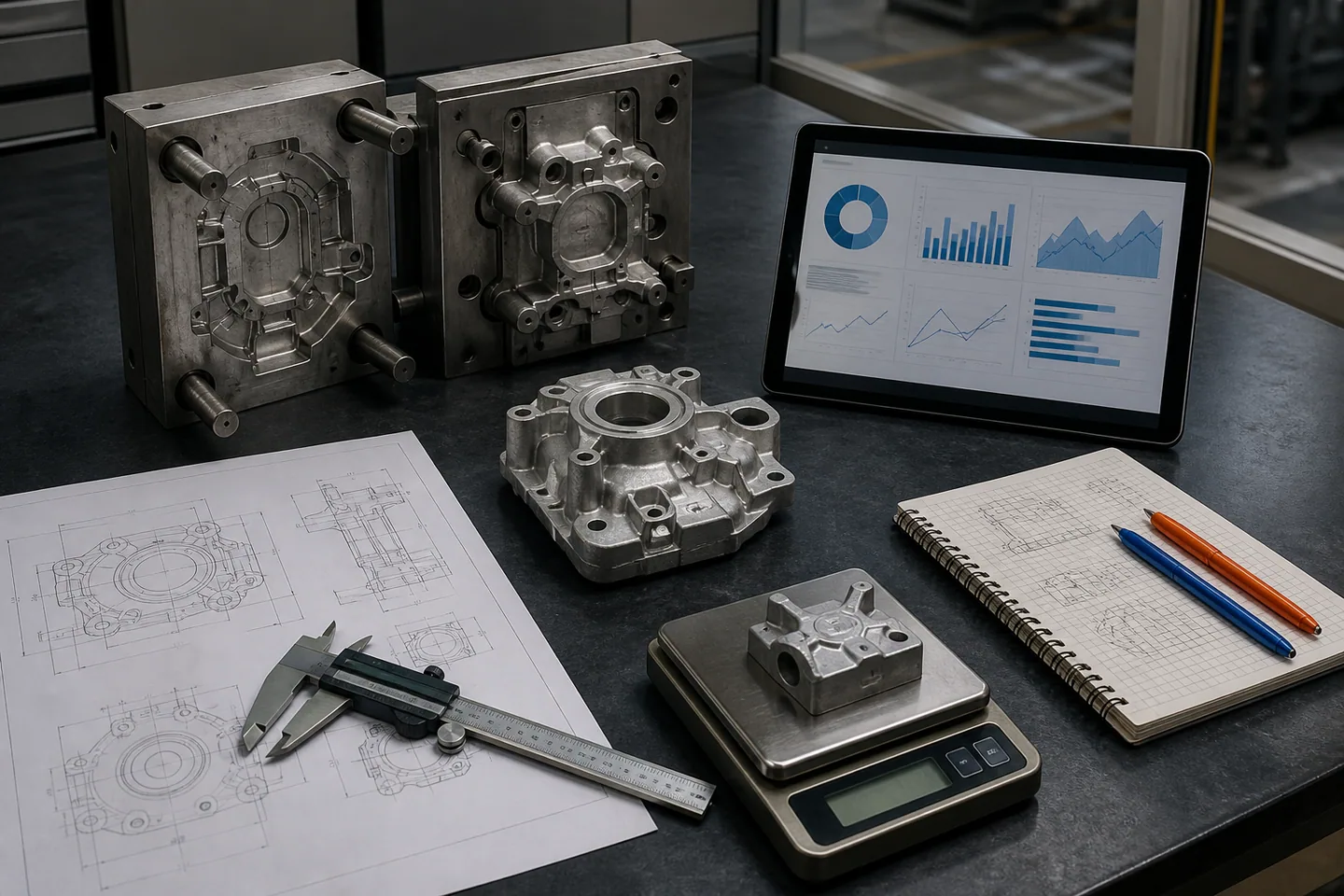
Send the alloy, controlled drawing, casting weight, runner and overflow estimate, cavity count, total projected area, wall range, quality-critical features, annual demand, target cycle, and any known cavity-pressure or injection requirements.
Start with the metal. Aluminum and many magnesium projects normally enter a cold chamber review, while compatible zinc work commonly enters a hot chamber review. Use the actual alloy designation where it is known. A general phrase such as "aluminum alloy" is enough for an initial conversation, but not for final process or equipment confirmation.
The supplier also needs the complete metal demand per shot. Net part weight omits runners, overflows, biscuit, and process allowance. If the die has not been designed, state that the value is an estimate and ask the supplier to show the basis used.
| RFQ field | Useful buyer input | Why it changes the review |
|---|---|---|
| Alloy and chamber route | Exact alloy, or material family marked provisional | Changes metal delivery, shot system, furnace, process window, and machine family. |
| Casting and complete shot | Net casting weight plus runner, overflow, biscuit, and cavities | Determines required metal volume and the candidate plunger or shot-sleeve package. |
| Total projected area | All cavities and feed system in the die opening direction | Forms the clamp-demand basis together with the approved pressure assumption. |
| Production duty | Annual demand, shifts, target cycle, changeovers, and uptime basis | Affects automation, thermal duty, storage, maintenance access, and acceptance testing. |
| Quality interfaces | Sealing zones, machining, finish, porosity limits, tests, and traceability | May change vacuum, process monitoring, die temperature control, handling, and data scope. |
For model-level screening, start with the complete die casting machine range, then compare the material route with the relevant cold chamber machine range or zinc hot chamber machine range. The listed specifications are screening inputs. The final model and configuration still require the project data.
RFQ gate 03 / simultaneous fit
Why must clamp, shot, and die fit pass together?
Nominal tonnage does not prove that a machine can run the part. The selected configuration must pass the clamp calculation, complete shot requirement, die envelope, injection duty, movement, access, and service limits at the same time.
Projected area and pressure basis
Record the total projected area, selected cavity-pressure basis, safety or operating margin, and the party responsible for approving the calculation.
Metal volume and injection package
Check complete shot mass and volume against the available plunger or shot-sleeve package, fill ratio, pressure, speed, and monitoring needs.
Physical envelope and movement
Confirm die width, height, thickness, weight, tie-bar clearance, opening stroke, ejector travel, slides, extraction path, lifting, and service access.
A larger model is not automatically a safer selection. Oversizing can change shot utilization, energy demand, footprint, die positioning, peripheral reach, and project cost. Ask each supplier to identify the limiting condition and show the calculation or data sheet used for the shortlist.
If a buyer already has a preferred model, I keep it in the brief as a reference. I also ask the supplier to identify the limiting condition because requested tonnage is still a preference until clamp, shot, die fit, and movement have been checked.
RFQ gate 04 / supply boundary
What belongs inside the production-cell RFQ?
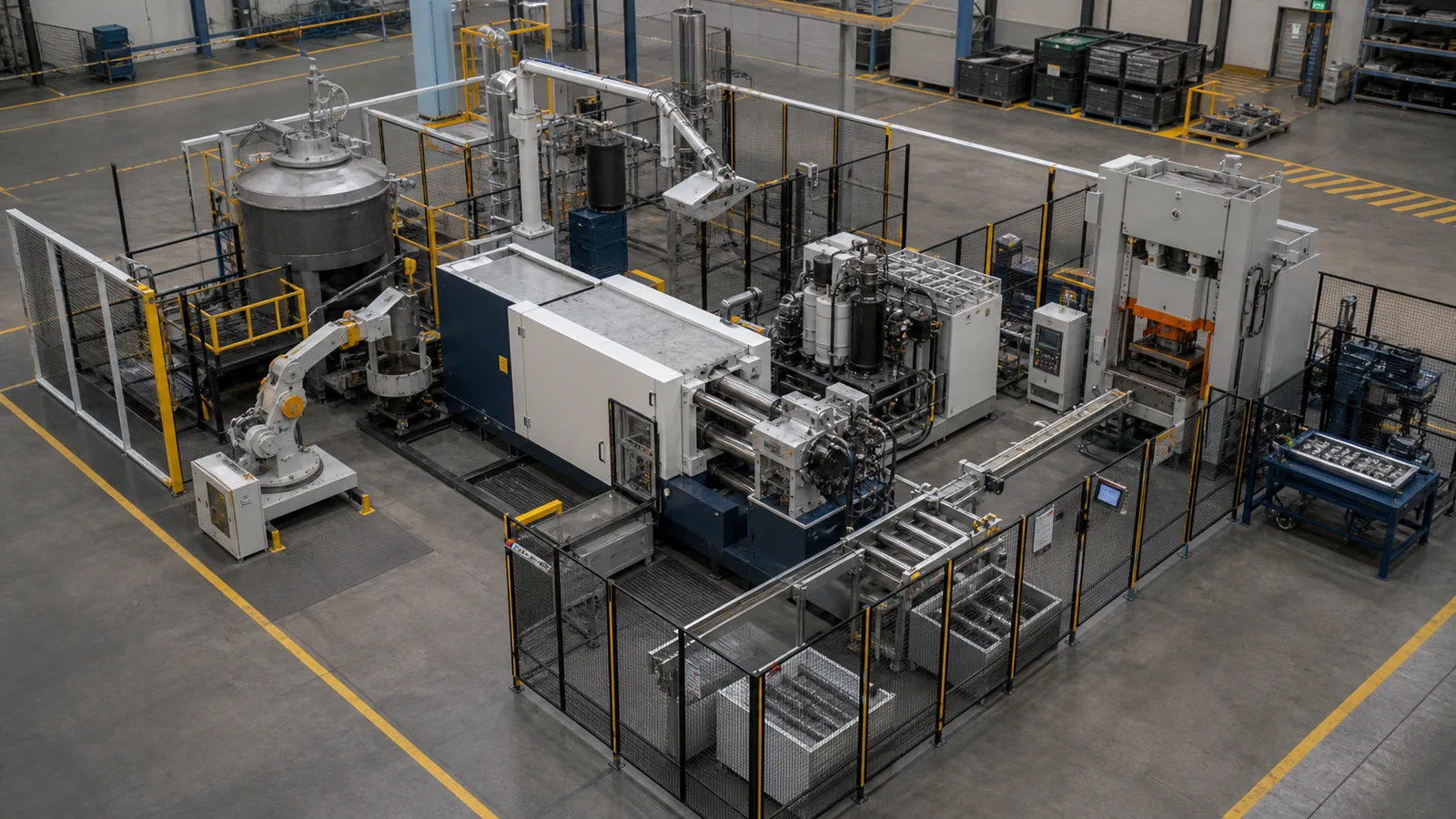
List every item needed to move from molten metal to an accepted casting, then classify it as supplier included, required option, buyer supplied, interface only, or excluded. A base-machine price cannot describe a complete cell.
The machine may need to coordinate with melting or holding equipment, metal transfer, spraying, extraction, cooling, trimming, conveying, vacuum, die temperature control, lubrication, inspection, marking, guarding, and centralized controls. The exact list depends on the casting and plant.
KUKA's die casting cell literature separates robots, spraying, removal, cooling, inspection, trim, conveyors, cell control, and enclosure as system elements, while also warning that illustrated equipment may be optional. That distinction is the reason every RFQ needs a written supply matrix. See the KUKA casting solutions brochure.
Included
Equipment, software, documentation, services, and tests inside the supplier's firm price.
Required option
Application-dependent equipment that must be priced separately but is needed for the approved process.
Buyer supplied
Plant equipment or services provided by the buyer, with the supplier's interface requirements stated.
Excluded
Items outside the offer, including civil work, rigging, utilities, consumables, or third-party validation where applicable.
RFQ gate 05 / destination plant
Which plant, safety, and electrical requirements must be stated?
State the installation country, voltage, frequency, available power, cooling-water conditions, compressed air, exhaust, floor or pit limits, route constraints, ambient conditions, network interfaces, required language, and the standards named by the buyer's responsible engineering team.
A supplier cannot infer compliance from the destination alone. The RFQ should name the applicable contract requirements and identify who is responsible for risk assessment, guarding integration, electrical verification, local inspection, and changes made after delivery.
ISO 12100 provides general principles for machinery risk assessment and risk reduction. IEC 60204-1 covers electrical, electronic, and programmable electronic equipment of machines from the supply connection point. Cite only the standards that the buyer and supplier agree to apply, including edition and local deviations where required.
Shipping split, packed dimensions, weights, lift points, port and road restrictions, door openings, crane coverage, and final setting route.
Machine reactions, pit or slab assumptions, anchoring, leveling, drainage, oil containment, and responsibility for civil drawings.
Power, grounding, water quality and duty, compressed air, exhaust, network, heat rejection, and connection boundaries.
Die change, shot-end service, accumulator inspection, guarding, operator space, maintenance clearance, and emergency egress.
RFQ gate 06 / quotation control
How should buyers compare die casting machine quotations?
Normalize every offer against one compliance matrix. Compare the proposed model, calculation basis, standard configuration, mandatory options, cell equipment, utilities, documents, testing, service, packing, delivery term, schedule, warranty, assumptions, and exclusions line by line.
A low base price may exclude the shot package, electrical adaptation, furnace, robots, guarding, factory test material, packing, commissioning, training, or spare parts required by the project. Ask the supplier to answer "comply," "deviation," or "not included" against each requirement rather than relying on a brochure.
| Comparison block | Evidence to request | Common hidden difference |
|---|---|---|
| Machine and shot system | Model sheet, selected plunger or sleeve, calculations, and deviation list | Same tonnage with different pressure capacity, monitoring, controls, or standard equipment. |
| Cell scope | Priced equipment list, layout, interface schedule, and responsibility matrix | Peripherals shown in an image but omitted from the commercial offer. |
| Acceptance | FAT and SAT protocol, test conditions, instruments, records, and closure process | "Standard test" without agreed load, duration, material, witness point, or pass criterion. |
| Documentation and service | Document index, language, format, training plan, commissioning days, and spare-parts list | Travel, translation, software backups, as-built files, or extra service days charged later. |
| Commercial delivery | Named Incoterms rule and place, packing method, schedule basis, payment, and warranty start | Freight cost and risk transfer described differently in otherwise similar prices. |
For international delivery, write the selected rule as a named place plus "Incoterms 2020." The International Chamber of Commerce explains that the rules allocate transport obligations, costs, and risk between seller and buyer. They do not replace the technical sales contract. See the ICC Incoterms 2020 guidance.

RFQ gate 07 / purchase release
What should be frozen before the purchase order?
Before release, make sure the approved specification, compliance matrix, final configuration, layout, utility schedule, responsibility matrix, document index, FAT and SAT protocol, delivery terms, warranty basis, schedule, and deviation list all describe the same machine project.
A website page, brochure, email, or preliminary quotation should not control a capital-equipment purchase by itself. Give every governing document a revision and define the order of precedence when two documents conflict.
Before a project is handed forward, I check that the model, options, destination, voltage, delivery term, and document revisions agree across the quotation and technical schedule. That is a commercial consistency check, not engineering approval.
- 01
Technical agreement
Approved application data, calculations, machine configuration, options, standards, interfaces, utilities, and accepted deviations.
- 02
Scope and layout
Equipment list, cell boundary, buyer supply, access zones, foundation inputs, route, footprint, and connection points.
- 03
Acceptance plan
FAT, SAT, sample or dry-cycle basis, instruments, witness points, records, nonconformance, correction, retest, and sign-off.
- 04
Commercial schedule
Price, payment milestones, delivery rule and place, packing, lead-time trigger, warranty start, service days, and change-control route.
Buyer questions / concise answers
Frequently asked questions about die casting machine RFQs
Can I request a quotation before the die is designed?
Yes. Label die dimensions, shot mass, projected area, and cycle as estimates where necessary. Ask the supplier to provide a budget model range, calculation assumptions, and a list of values that must be confirmed before order.
Is part weight enough to select machine tonnage?
No. Part weight contributes to shot demand, while clamp demand depends on total projected area and the approved pressure basis. The die must also fit the platen, tie-bar opening, thickness range, opening stroke, ejector system, and handling route.
Should buyers specify a preferred machine model?
You can list a preferred model for comparison, but include the casting and die data that support it. Ask the supplier to confirm suitability, identify the limiting condition, and propose an alternative if the preferred model fails a fit gate.
What attachments shorten the first review?
A controlled 2D drawing, 3D model where authorized, die layout or dimensions, casting and complete shot weights, projected-area record, current process sheet, plant utility standard, proposed cell layout, and destination requirements are useful starting documents.
Should FAT and SAT be in the RFQ or agreed later?
Put the required acceptance framework in the RFQ. Detailed protocols can develop during engineering, but the commercial offer should already state test location, material or dry-cycle basis, duration, witnesses, records, pass criteria, defect closure, and responsibility for site conditions.
How can I get a Luxue model recommendation?
Send the casting drawing, alloy, complete shot estimate, projected area, die dimensions, output target, automation boundary, plant utilities, destination, and required standards through the machine quotation form.
Conclusion: Is the RFQ ready to send?
If two suppliers can interpret the RFQ as two different production cells, it is not ready for a final price comparison. Separate confirmed data from supplier calculations and open points, define the complete supply boundary, and attach acceptance criteria before price becomes the deciding column.
For an initial Luxue review, I do not expect every value to be final. I can work with a drawing and an honest list of unknowns more effectively than with a confident tonnage guess that no one has verified.
Send your machine requirements